Key Takeaways
- Singapore’s competitive digital economy demands specialist SEO partners; not all agencies deliver equal value across technical, content and link-building work.
- Five main agency models exist: in-house teams, boutique specialists, full-service agencies, enterprise consultancies and hybrid/offshore models, each with distinct cost-to-value trade-offs.
- Mid-market retainers (SGD 2,500–6,000 per month) typically deliver measurable ROI within 12 months for SMEs; cheaper options rarely hire experienced staff; premium pricing requires rigorous evaluation.
- Red flags include guaranteed rankings, refusal to grant data access, poor communication speed, vague case studies and absence of technical SEO discussion.
- Realistic timelines span 1–3 months for foundation work (no ranking gains), 4–6 months for initial traction on long-tail keywords, and 7–12 months for competitive keyword gains; any agency claiming first-page results in 30 days is overpromising.
- Use the provided diagnostic checklist to score shortlisted agencies on methodology, team experience, transparency, communication and references before signing a contract.
Table of Contents
- Why SEO Matters in Singapore’s Digital Economy
- The Five Main Types of SEO Agency in Singapore
- Agency Selection Criteria: What to Evaluate
- Red Flags and Warning Signs
- SEO Pricing and Costs in Singapore
- Core Services Most Agencies Offer
- How to Evaluate an Agency Before You Hire
- Agency Selection Framework: Decision Checklist
- Setting Realistic Expectations: SEO Results Timeline
- Questions to Ask Your Shortlisted Agencies
- Frequently Asked Questions
Introduction
Singapore’s digital economy has matured dramatically. Companies no longer compete only with neighbours on the same street; they compete with global competitors on the same search results page. With 88% of Singapore’s 5.9 million people online, search visibility has shifted from “nice to have” to existential. Yet not all SEO agency partners are built the same way.
Some agencies specialise in technical audits and site architecture. Others focus almost entirely on link-building and digital PR. Still others position themselves as full-funnel strategists, handling everything from keyword research to content production to conversion optimisation. A few operate as one-person freelance operations; others field teams of 20+ specialists across multiple disciplines.
This article maps the SEO agency landscape in Singapore so you can identify the type of partner that aligns with your business stage, budget and growth goals. By the end, you’ll understand the five main agency models, how to spot red flags, what realistic timelines look like, and a decision framework to shortlist and evaluate candidates. Whether you’re a first-time buyer or switching providers, this guide cuts through the noise.
Why SEO Matters in Singapore’s Digital Economy
The shift in how Singaporean businesses compete online
The pandemic accelerated digital adoption across ASEAN, but Singapore didn’t just catch up: it leapfrogged. Today, 88% of Singapore’s 5.9 million people are internet users, with average daily usage now exceeding 8 hours. More significantly, 80% of purchase decisions begin with a search query.
Companies no longer compete only locally. They compete regionally and globally, with a single search result potentially exposing them to customers from Malaysia, Indonesia and beyond. A restaurant in Tanjong Pagar that ranks for “best Chinese restaurant near me” captures walk-in traffic. A B2B software firm that ranks for “enterprise SaaS accounting software” captures qualified leads worth thousands of dollars per conversation. A lack of search visibility doesn’t mean you’re invisible locally; it means you’re invisible to the people actively looking for what you sell, right now, at the moment they’re ready to buy.
Search visibility is no longer a “nice to have”. It’s the primary channel through which customers discover you, evaluate you and choose you over competitors. This shift has reshaped how Singaporean SMEs and enterprises allocate marketing budgets. Paid advertising works, but it stops working the moment you stop paying. SEO is the inverse: it compounds. A dollar spent on SEO today builds equity that pays dividends for months or years. This is why working with an SEO agency Singapore has become a board-level conversation, not a “let’s try it and see” experiment.
How SEO has evolved since 2024
The SEO playbook of 2023 is no longer sufficient. Three major shifts have reshaped how agencies must work.
Core Web Vitals dominance. Google’s three Core Web Vitals (Largest Contentful Paint, First Input Delay, Cumulative Layout Shift) are now full ranking factors. A site that loads in 2 seconds but wobbles visually as images load loses to a 3-second site that feels smooth. Agencies that treat performance as an afterthought are behind the curve. Leading agencies now bake Core Web Vitals into every decision: image format selection, script deferral, CSS critical rendering path analysis.
AI-powered search results rewarding E-E-A-T signals. Google’s Search Generative Experience now summarises answers directly in search results, reducing clicks to organic listings. The agencies that benefit most are those whose clients build demonstrable expertise, experience and authority. This means original research, case studies with named results, author bylines with verified credentials, and content that reflects deep domain knowledge, not surface-level rephrasing of competitors.
Entity-based semantic search and the decline of exact-match keyword targeting. Search engines no longer match strings; they match intent via entity relationships. Searching “best accounting software for startups in Singapore” returns results about entities (Xero, Wave, FreshBooks) and their relationships to “startup”, “accounting”, “compliance” and “Singapore”, not websites that happen to contain those words in that order. Agencies still optimising for exact-match keywords are optimising for a vanished world. Competent ones now map topical authority: they build content clusters around a core entity (e.g., “startup accounting”), ensuring related subtopics all reinforce the central theme.
Agencies that haven’t updated their playbook since 2023 are selling yesterday’s solution. A retainer focused purely on “ranking you for 30 keywords” without mentioning Core Web Vitals, topical authority or entity-based optimisation is a retainer you should skip.
The Five Main Types of SEO Agency in Singapore
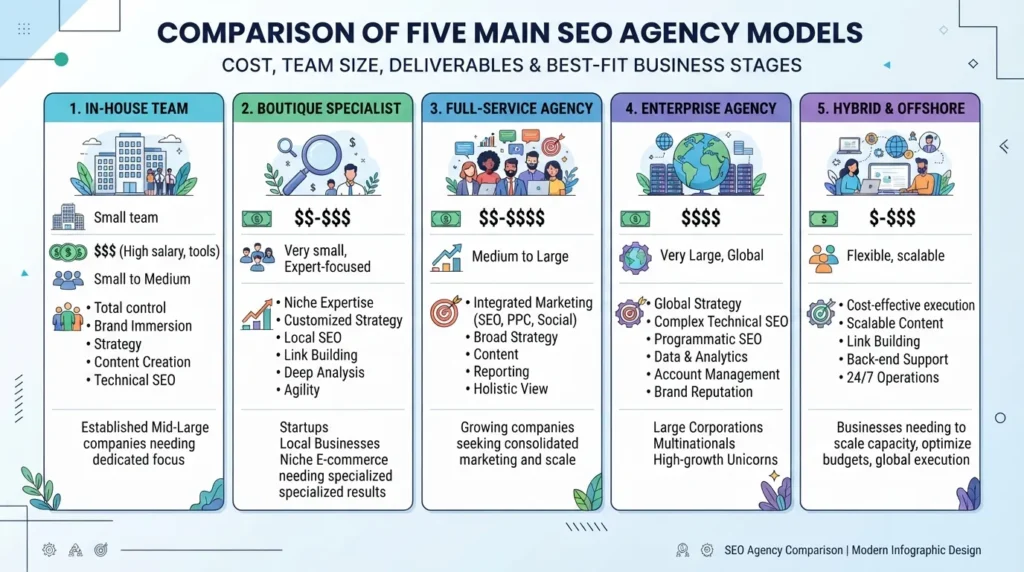
Singapore’s SEO market fragments into distinct agency archetypes, each suited to different business needs and budgets. Understanding which model aligns with your goals is the first step to a successful partnership.
In-House Teams: Freelancers and Small Squads
A freelancer or two-person squad operates as an extension of your internal marketing team. Cost is low upfront: typically SGD 1,500–3,500 monthly for a part-time or fractional resource. Output tends to be slower because a single person juggles multiple priorities.
Expertise is narrow by design. A freelancer might excel at technical audits or content writing but lacks the breadth to manage a full-funnel strategy. This model works if you have a single, defined need (fixing crawlability issues on your e-commerce platform) and internal capacity to manage coordination and quality assurance.
Pros: Flexibility. Direct access to the person doing the work. No account manager overhead. Lower cost.
Cons: Limited accountability when projects stall. No team backup if the freelancer becomes unavailable. Expertise gaps in areas outside their specialty. Scaling is friction-heavy.
Red flag: Accountability becomes murky when work stalls. A freelancer juggling five clients may deprioritise yours.
Best for: Startups with limited budgets, companies treating SEO as experimental, or well-resourced internal teams needing short-term specialist input.
Boutique Specialist Agencies
These agencies go deep into a single vertical: e-commerce, SaaS, news publishing, healthcare, legal services or fintech. Cost is mid-to-high (typically SGD 3,000–8,000 monthly) because they command premium rates for mastery.
Output is consistently high within their niche. A boutique e-commerce agency understands product-page canonicalisation, faceted navigation and conversion optimisation in ways a generalist cannot. They carry battle-tested playbooks and often own relationships with relevant journalist networks and link-building communities.
Pros: Genuine depth of expertise. Faster ramp-time because they know the vertical playbook. Relevant case studies. They understand your competitors and search behaviour.
Cons: Risk of over-specialisation. They may miss cross-functional opportunities or push tactics that fit their playbook rather than your stage. Smaller teams mean less backup capacity.
Red flag: They dismiss opportunities outside their vertical as “not our focus”. Flexibility matters in SEO.
Best for: Companies in competitive verticals with substantial budgets, willing to pay for mastery and depth. Growth-stage companies where domain knowledge drives measurable ROI.
Full-Service Digital Marketing Agencies
Full-service shops bundle SEO alongside paid search, social media, design, email marketing and sometimes video production. Cost is high: retainers often start at SGD 5,000 monthly and climb to SGD 15,000+ for a dedicated team.
Output is variable. These agencies excel at integrated campaigns where SEO messaging syncs with paid ads and landing-page design. But SEO is often treated as a loss-leader, subsidising more profitable channels like paid search. Your account may be staffed with junior practitioners while senior strategists focus on higher-margin work.
Pros: Integrated messaging across channels. One point of contact for all digital work. Campaign budgets can be optimised across channels. Larger teams and backup capacity.
Cons: SEO frequently becomes a loss-leader. Your dedicated SEO headcount may be junior. Slower decision-making due to committee approval. Success metrics become muddled.
Red flag: You speak only to an account manager who doesn’t understand the technical details of your SEO strategy. That signals deprioritisation.
Best for: Large brands needing cohesive messaging across channels, or companies running significant paid-media budgets that benefit from integrated planning.
Enterprise and Retained SEO Consultancies
These are strategy boutiques: firms that work exclusively on retained contracts with multinational companies, high-revenue targets or enterprises with complex technical estates (multi-brand, multi-language, 50,000+ pages).
Cost is high (typically SGD 8,000–25,000+ monthly) because you’re paying for strategic guidance, not labour. You’re buying access to senior practitioners, often ex-Google or ex-Amazon, who audit your entire digital footprint and advise your internal team.
Output is strategic guidance plus oversight of your in-house team. The agency doesn’t necessarily execute all the work; they define the playbook, review progress and course-correct quarterly. Expect a 3–6 month ramp before visible results because strategy requires diagnosis and stakeholder alignment first.
Pros: Executive-level strategic thinking. Multi-year roadmaps. Often bring network effects: journalist relationships, link-acquisition partnerships, access to tools and data you wouldn’t buy alone. Clear accountability measured on outcomes, not activity.
Cons: Expensive. Requires internal team capacity to execute their recommendations. Results take 3–6 months to appear. Often come with minimum contract terms.
Red flag: They deliver a 50-page strategy document and then disappear. Ongoing partnership and accountability matter.
Best for: Multinational companies, high-revenue e-commerce platforms, enterprise software firms, or businesses with complex technical estates requiring external strategic oversight.
Hybrid and Offshore Models
Some agencies blend onshore strategy staff (in Singapore) with nearshore execution teams (Philippines, India, Vietnam). Cost is low-to-mid: SGD 1,500–4,000 monthly.
The appeal is obvious: lower labour costs in execution-heavy work (content production, link outreach, basic technical fixes). The risk is equally real: quality variance across time zones, communication delays, and junior practitioners delivering cookie-cutter work. A hybrid model only works if the onshore lead is genuinely senior and maintains rigid quality control.
Pros: Cost-effective. Scalable execution. Onshore oversight with offshore labour cost.
Cons: Quality variance. Communication delays across time zones. Knowledge loss if offshore staff turn over. Requires clear processes and documentation.
Red flag: You never meet or interact with the offshore team. That signals cost-cutting, not optimisation.
Best for: Budget-conscious SMEs with clearly defined, repeatable projects (e.g., monthly blog production). Avoid if your needs are high-touch or require rapid iteration.
Choosing between these models requires clarity on three factors: your budget ceiling, the complexity of your needs, and how much ongoing strategic guidance you require versus execution labour. A startup might hire a freelancer for three months to audit the site, then upgrade to a boutique specialist for long-term growth. A multinational might layer a retained consultancy (strategy) with a boutique agency (execution) in two markets. There is no universal “best” type, only a best fit for your stage and resources.
Agency Selection Criteria: What to Evaluate
When you’ve narrowed down to a shortlist of potential partners, the real work begins. How you evaluate them separates agencies that deliver from those that consume your budget without results.
Track Record and Case Studies
Ask for concrete results: traffic growth percentages, keyword rankings gained, revenue attribution. Red flags include vague language like “improved rankings”, client names they won’t disclose, or absence of before-and-after metrics.
Legitimate agencies publish case studies with client permission or share anonymised data. Look for specificity: “Increased organic traffic 150% in 9 months” beats “Delivered strong results”. Ask whether the case study client operated in your sector, faced similar technical constraints and competed at your keyword difficulty level.
Request access to a client reference in your industry. Call them directly. Ask: Did the agency hit its KPIs? Would you hire them again? How responsive were they during crises like algorithm updates?
Team Composition and Certifications
Who owns your account? What’s their experience level? Ask to review their LinkedIn profile. How long have they stayed at previous roles? High turnover (less than 2 years per role) signals instability.
Google Partners status, HubSpot certification or SEMrush Advanced certification add credibility but aren’t mandatory. What matters more is domain-specific experience: has your account lead managed sites in your vertical before?
Crucially, ask how much time your dedicated lead spends on your account monthly. A full-time retained lead is standard for mid-market clients (SGD 2,500+ retainers). Entry-level retainers (SGD 1,000 per month) may assign a shared resource across 5–10 clients; clarify this upfront.
Methodology and Reporting
How will they audit your site? What’s their sequence of work? What does monthly reporting include?
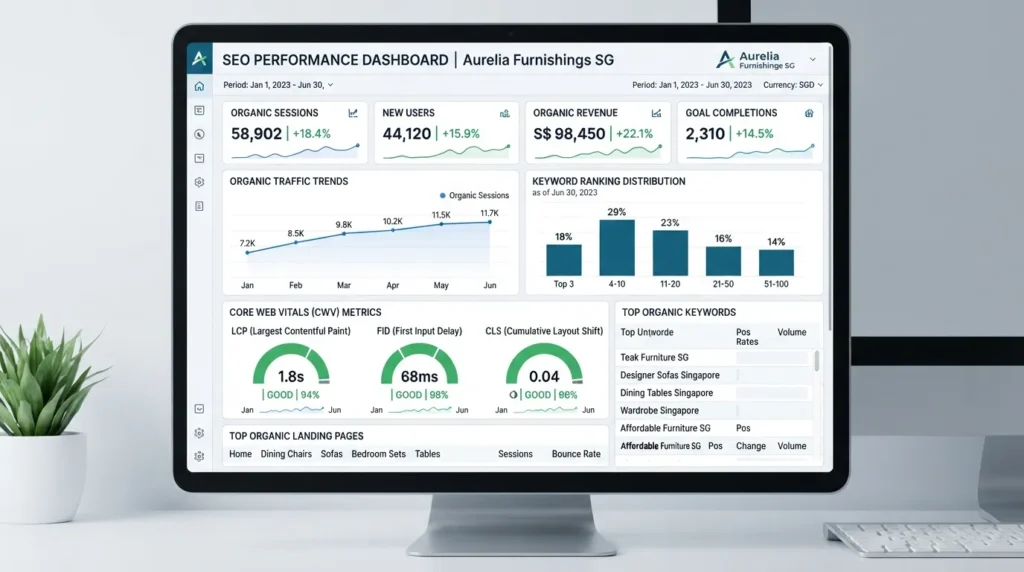
Trustworthy agencies show you their playbook before you sign. They explain why they prioritise certain work and in what sequence. They define success metrics in your kickoff call, not month 3.
Beware of guarantees. “We guarantee first-page rankings in 90 days” is a red flag. Google’s algorithm is competitive and constantly evolving. No agency controls search results; they can only optimise your site and acquire authority. Legitimate agencies discuss timelines (6–12+ months for competitive keywords) and probability, not certainty.
Communication and Transparency
Will you have monthly calls? A Slack channel for ad-hoc questions? A clear escalation path if issues arise? Do they explain why they’re making changes, not just what they changed?
An agency that educates you about SEO is more valuable long-term than one that hoards knowledge. You should understand their strategy well enough to make informed decisions with them.
Request full access to Google Search Console and Google Analytics 4 from day one. You own that data; the agency should be transparent about what it reveals. Agencies that offer “summary dashboards only” are hiding something (usually underperformance or junior-level analysis).
Response time matters. Expect replies to emails within 24 hours. If they’re slow during the sales process, they’ll be slower after you sign.
Pricing Models: Retainer vs. Project vs. Performance
Three common pricing structures exist in Singapore’s market.
Retainer. A fixed monthly fee, usually SGD 1,500–10,000+. You get predictable budgeting, a long-term partnership, and continuity of knowledge. The agency is incentivised to deliver results because you’ll renew based on performance. Most common for SMEs and mid-market firms.
Project-based. A fixed fee for a defined scope: technical audit (SGD 1,500–4,000), site migration (SGD 3,000–8,000), or a content strategy sprint (SGD 2,000–6,000). Clear boundaries; useful for one-off work. Weakness: no ongoing optimisation after delivery.
Performance-based. Fee tied to rankings, clicks or revenue. Rare in Singapore; carries perverse incentives. An agency paid only on first-page rankings may pursue short-term tactics over sustainable growth. Avoid unless structured very carefully.
Hybrid models. A retainer plus a bonus for hitting KPIs (e.g., “SGD 3,500 per month + 10% of revenue gains above baseline”). Increasingly common for high-growth companies. Aligns incentives but requires transparent attribution.
For most SMEs seeking sustainable growth, a monthly retainer (SGD 2,500–5,000) paired with clear KPIs is the safest choice.
Red Flags and Warning Signs
Unrealistic Promises
“Top 3 rankings in 30 days.” “Guaranteed first-page results”. “Ranking for [competitive keyword] in 90 days.”
Google’s algorithm is opaque and competitive. Any agency that guarantees rankings is either lying or relies on black-hat tactics, which will harm you long-term and incur penalties. Legitimate agencies discuss probability and timelines. “Competitive keywords typically take 6–12 months” is honest. “We guarantee first page” is a warning.
Black-Hat Tactics
If an agency suggests private blog networks (PBNs), link farms, keyword stuffing, cloaking or other manipulation, walk away immediately. Google has invested billions in detecting and penalising these tactics. A penalty can take 1–2 years to recover from and permanently damage your domain authority.
Lack of Transparency
They won’t grant you access to Google Search Console or Analytics. They dismiss technical questions as “too technical”. They don’t explain their methodology. You own your data and your domain. Any agency that obscures the work is hiding inefficiency or unethical practices.
Poor Communication
Slow email replies (more than 24 hours), vague monthly reports, no clear point of contact, or sudden staff changes without warning. These predict poor outcomes. If they can’t communicate during the sales phase, they won’t improve after you sign.
No SEO Fundamentals Discussion
They mention only link-building and ignore content strategy, technical health or user experience. SEO is a tripod: content, technical foundation and authority. Miss any leg and you stall. An agency that promises rankings purely through links is overselling one lever.
SEO Pricing and Costs in Singapore
Understanding what different price points buy is essential to avoiding waste or underpaying for value.
Entry-level (SGD 1,000–1,500 per month). Shared resources, often junior staff. Expect basic on-page optimisation, monthly reporting. No strategic direction. Good for experimenting with SEO or for maintenance of an already-established site.
Mid-market (SGD 2,500–6,000 per month). Dedicated account lead (1–3 hours weekly), small tactical team. Includes audit, on-page fixes, content strategy and basic link-building. Realistic for SMEs seeking first-page rankings on long-tail keywords within 6–9 months. Best ROI band for most businesses.
Premium (SGD 6,000–12,000+ per month). Full-time dedicated team, strategic guidance, account manager, project manager. Includes all of the above plus paid-media coordination, advanced reporting, priority support. For mid-market and growth-stage firms.
Enterprise (SGD 12,000–25,000+ per month). Senior strategist, retained partnership, custom research, competitor intelligence. For multinational companies, high-stakes SEO or complex technical estates.
A common mistake is choosing based on price alone. A SGD 1,500 per month retainer sounds cheaper than SGD 4,000 per month, but if the cheaper option delivers no rankings while the premium option delivers measurable traffic, the premium option earned its fee. Likewise, paying SGD 15,000 for a generalist agency when a SGD 4,000 specialist could deliver the same results is waste.
Core Services Most Agencies Offer
Technical SEO
Auditing and fixing crawlability, indexation, site architecture, mobile responsiveness, page speed and structured data. Essential. If an agency doesn’t mention this, skip them.
On-Page Optimisation
Title tags, meta descriptions, heading hierarchy, internal linking, keyword placement. Table-stakes. Important but not sufficient on its own.Content Strategy and Production
Keyword research, content gap analysis, article writing, content calendar management. Often included in mid-market retainers; sometimes outsourced or charged separately.
Link-Building and Digital PR
Acquiring backlinks through journalist outreach, guest posts, resource pages, partnerships. Important for competitive keywords. Quality varies hugely; ask for examples.
Reporting and Analytics
Monthly dashboards tracking rankings, traffic, conversions. Standard. Insist on access to raw data, not summary views only.
Competitor Analysis
Benchmarking your performance against competitors, identifying ranking opportunities. Valuable for strategy but can be surface-level if not paired with deeper technical audit.
Not all agencies offer all services. Many outsource content production or link-building. Clarify what’s in-house versus outsourced before signing.
How to Evaluate an Agency Before You Hire
Run a discovery call and assess their approach
Request a free 30-minute discovery call. During the call, listen for:
- Do they ask questions about your business, competitors and goals before proposing solutions? (Good sign.)
- Do they launch into a generic pitch about “rankings” and “traffic”? (Bad sign.)
- Can they articulate your competitive landscape without you spelling it out? (Good sign: they’ve done homework.)
- Do they explain their methodology step-by-step or keep it vague? (Transparency matters.)
The call should feel collaborative, not transactional.
Request a sample audit or proposal
Ask for a lightweight technical audit or keyword opportunity analysis (they may charge SGD 500–1,000 for this, which is reasonable). Review the output. Does it identify specific, actionable issues? Or is it generic boilerplate?
A good audit includes: crawl error breakdown, page speed metrics, mobile usability issues, top competitor comparisons, keyword opportunity chart with search volume and difficulty, and a prioritised action plan.
Check references and case studies
Never hire based on case studies alone. Request 3 client references in your sector and call them. Ask:
- Did they hit their promised timelines and KPIs?
- How responsive was the agency to crises (algorithm updates, technical issues)?
- Would you hire them again?
- What surprised you about working with them (positive or negative)?
A reference who hesitates or gives conditional praise is a yellow flag.
Assess cultural fit
You’ll work closely with this partner for 6–12 months. Do they understand your business? Do they communicate in a way that fits your team’s cadence? Are they patient educators or condescending experts?
A mismatch in communication style or values will create friction and slow progress. Trust matters.
Agency Selection Framework: Decision Checklist
Use this checklist to score shortlisted agencies (1 = weak, 5 = strong) and make a final decision.
| Criterion | Weight | Agency A | Agency B | Agency C |
|---|---|---|---|---|
| Track record in your sector | 5 | _ | _ | _ |
| Transparency and data access | 5 | _ | _ | _ |
| Team experience and tenure | 4 | _ | _ | _ |
| Communication speed and style | 4 | _ | _ | _ |
| Realistic timelines and promises | 4 | _ | _ | _ |
| Pricing alignment with budget | 3 | _ | _ | _ |
| Reference feedback | 5 | _ | _ | _ |
| Technical SEO methodology clarity | 4 | _ | _ | _ |
| Content strategy detail | 3 | _ | _ | _ |
| Cultural fit | 3 | _ | _ | _ |
Total out of 50 (multiply each score by its weight and sum).
Aim for a score of 35+. Below 30 signals red flags. Scores 40+ represent strong candidates. Don’t hire based on lowest price alone; weight this checklist toward track record, transparency and communication over cost.
Setting Realistic Expectations: SEO Results Timeline
Understanding the SEO arc prevents disappointment and helps you assess whether an agency is delivering.
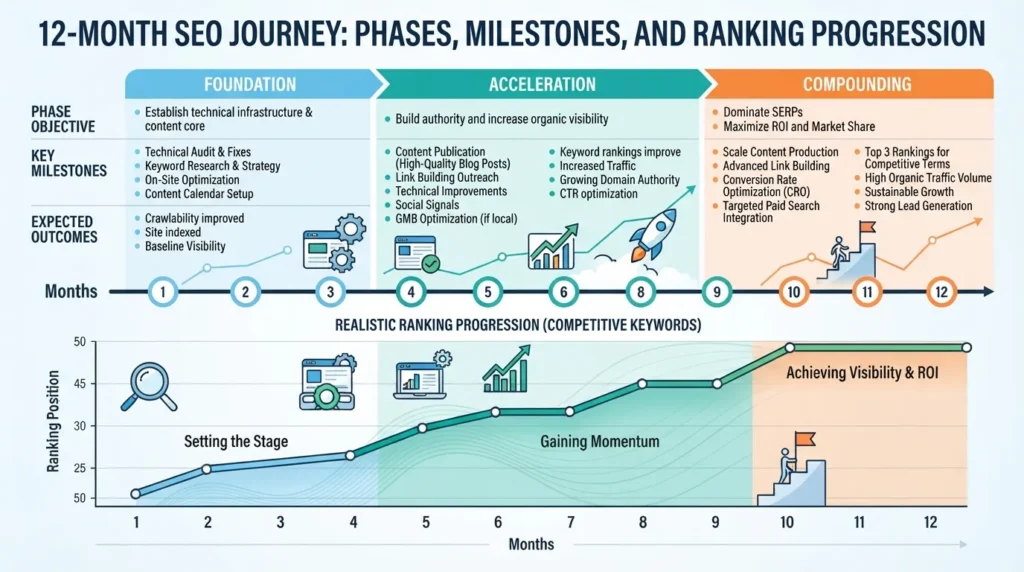
Months 1 to 3: Foundation Phase
Expect: Site audit completion, critical on-page fixes deployed, first 10–15 content pieces published, initial outreach campaigns launched.
Ranking movements: Minimal. You’re too new to the agency’s process to see gains yet.
Traction metric to watch: Indexation increases, crawl errors resolve, Core Web Vitals improve, internal linking strengthens. Ask your agency for a “month 1 wins” summary: bugs fixed, pages optimised, top 10 technical changes deployed.
Do not judge the agency on ranking gains yet. Judge them on the clarity and pace of their foundation work.
Months 4 to 6: Acceleration Phase
Expect: Content momentum builds, backlinks accumulate, rankings on long-tail keywords (low volume, high intent) climb. Organic traffic may grow 15–30%.
Be wary of agencies claiming homepage rankings for competitive terms by month 6. It’s unlikely unless your domain already had authority or the keyword is low-competition.
Long-tail keywords are the early wins. If an agency claims you’re ranking for “enterprise SaaS accounting software” but delivers nothing, that’s a problem. If they show you ranking for “best accounting software for one-person startups” and “how to switch accounting tools,” that’s legitimate progress.
Months 7 to 12: Compounding Phase
Expect: Dominant long-tail rankings, secondary keyword gains, traffic up 40–100% year-on-year. Authority keywords (high volume, high competition) may still rank page 2–3. That’s normal and will shift in months 12–18.
This is the phase where retention and momentum matter. Sustainable growth requires 12+ months because authority builds over time and search engines reward established, comprehensive coverage of a topic.
Year 2 and Beyond
Diminishing returns set in; most easy gains are captured. Year 2 focus shifts to optimising conversion rate, doubling down on highest-intent keywords and expanding into adjacent topics. Growth flattens unless you increase content volume or acquire more authority (backlinks, brand mentions).
Why timelines matter: An agency that overpromises month 3 results will lose your trust by month 4. A credible agency warns you of these phases upfront and adjusts expectations quarterly based on actual data.
Questions to Ask Your Shortlisted Agencies
What would a 6-month audit of our site look like, and what would it cost?
This reveals their discovery process and pricing transparency.
How do you prioritise work? Which keywords or pages would you tackle first and why?
Listen for strategic thinking, not just “we’ll rank you for everything.”
Give me an example of a client similar to ours (sector, size, competition level). What KPIs did you set and achieve?
Demand specificity and relevance. A SaaS case study means little if you run e-commerce.
If we disagree on strategy, say, you recommend a 50-article content calendar and we want to cut costs, how do we resolve that?
This tests whether they’ll educate you or rubber-stamp your decisions.
How do you handle Google algorithm updates? Do you provide immediate guidance or wait to see impact?
Good agencies have a documented protocol.
What does your reporting include? Can we access raw GA4 and GSC data, or only your summary dashboard?
Transparency predicts long-term partnership success.
If we hit our revenue goals in month 9, can we pause and resume later, or are we locked into a 12-month contract?
Understand exit clauses and flexibility upfront.
What’s your approach to link-building? Do you manage outreach in-house or outsource it? Can you show me examples?
Link quality varies massively. In-house typically signals higher quality control.
How many clients do you currently manage? How much time would my dedicated lead spend on my account per week?
Shared resources across 20+ clients mean diluted attention.
Walk me through your last 3 months of work for a client at our stage. What did you deliver each month, and what happened to their traffic and rankings?
Demand concrete, time-bound examples.
Conclusions
Choosing an SEO agency is one of the highest-leverage decisions you can make for organic growth. The right partner compounds your visibility year on year; the wrong one wastes months and budget.
Use this framework to: (1) identify which agency model fits your stage and budget; (2) evaluate shortlisted partners on track record, methodology and transparency; (3) spot red flags early; (4) set realistic timelines; and (5) make a final decision using the scoring checklist.
The five agency models all work for the right fit. A freelancer is ideal if you have a defined, one-off need. A boutique specialist makes sense if you’re in a competitive vertical and willing to pay for mastery. A full-service agency fits integrated campaigns. A retained consultancy suits multinational enterprises. A hybrid model works for budget-conscious teams with repeatable work.
What matters most: hire an agency that’s transparent about what they’ll do, honest about timelines, and committed to your long-term growth over quick wins. Ask for references, run a discovery call, and use the checklist before you sign. Good partnerships are hard to find; when you find one, protect it.
Frequently Asked Questions
How long does SEO actually take to show results?
Foundation work takes 1–3 months (no ranking gains). Long-tail keywords start ranking by month 4–6. Competitive keywords take 7–12+ months. “Immediate results” claims are red flags.
What’s a good budget for SEO as a percentage of revenue?
For SMEs, 0.5–2% of annual revenue is typical. A business earning SGD 100,000 annually might allocate SGD 500–2,000 monthly to SEO. For high-growth companies, 3–5% is not uncommon if ROI is proven.
Should I hire an agency or build an in-house team?
Hire an agency if: you’re early-stage, don’t have internal expertise, or need immediate traction. Build in-house if: you have consistent high-volume needs, can attract senior talent and want full control of strategy. Many companies do both: an agency for strategic guidance, an in-house hire for execution.
Can I switch agencies mid-contract without losing my rankings?
Yes, but it creates risk. Rankings don’t disappear when you switch, but there’s a transition period (1–3 months) where continuity is broken. New agencies need time to audit your site and understand what was done. Contractual terms matter; avoid long lock-in periods if you’re unsure.
What’s the difference between “white-hat” and “black-hat” SEO?
White-hat follows Google guidelines: quality content, fast load times, earning authority through merit. Black-hat manipulates the algorithm: keyword stuffing, cloaking, PBNs. White-hat takes longer but is sustainable. Black-hat risks penalties that kill your domain. Any agency suggesting black-hat tactics should be rejected immediately.
How do I know if an agency is genuinely hitting my KPIs or inflating numbers?
Request direct access to Google Search Console and Google Analytics 4. Compare their reported numbers to raw data. If they claim 50% traffic growth but GA4 shows 15%, that’s a red flag. Transparent agencies encourage you to verify their numbers independently.
What should I do if an algorithm update tanks my rankings?
A good agency provides immediate analysis: which pages dropped, why, and what changed in Google’s guidance. They’ll then adjust your strategy (doubling down on E-E-A-T, improving user experience, etc.). A slow or absent response is a sign they don’t have active monitoring in place.
Is it worth paying for premium agencies (SGD 8,000+) versus mid-market (SGD 3,000–5,000)?
It depends on your business stage and revenue. A high-revenue e-commerce site competing on “buy now” keywords can justify SGD 8,000+ retainers because ranking gains compound revenue. A bootstrapped startup often gets better ROI from a SGD 3,000 boutique specialist. Don’t overpay for prestige; pay for proven results in your vertical.