Finding the right SEO agency in Singapore feels harder than it should be. You’ll find dozens of agencies claiming top rankings and guaranteed results, but when you dig into their case studies, pricing remains opaque and promises sound identical to every competitor’s pitch. The real differentiator isn’t who shouts loudest about their wins; it’s who can show you a transparent, ethical process and deliver results that actually move your business metrics.
This guide cuts through the noise. We’ve evaluated Singapore’s most established agencies against seven concrete criteria: transparency, local expertise, technical capability, content strategy, link quality, proven results, and price fairness. Each agency receives a scored breakdown so you see exactly why they ranked where they did. You’ll also get a selection checklist, pricing reality check, and red flags to watch for. By the end, you’ll have a framework to choose the right partner for your stage and budget, not the loudest one on the SERP.
Key Takeaways
- Evaluation matters now more than ever. Google’s March 2024 core update and May 2024 AI Overviews launch reshaped ranking fundamentals. Agencies that adapted gained competitive edge; those still using old playbooks are losing ground.
- Seven transparent criteria separate good agencies from great ones. Transparency and ethics (20%), Singapore-specific expertise (18%), technical SEO skill (17%), content and search intent alignment (15%), link building quality (12%), proven results (10%), and fair pricing (8%) are your scorecard.
- Price ranges: Budget tier (S$500–S$1,500/month for local, low-competition keywords); mid-market (S$800–S$3,000/month for SME growth); premium (S$2,500–S$8,000+/month for enterprise or highly competitive verticals). PSG and MRA grants can cut your effective cost by 50–70%.
- Top standouts in 2026: MediaOne (8/10, trusted 16+ years, 3,000+ clients), Impossible Marketing (8/10, in-house team, verified 300%+ growth case studies), and First Page Digital (7/10, specialist in competitive keywords). Each excels in different scenarios.
- Timeline reality check. Ethical agencies show page 6–10 movement by month 3–4, meaningful top-5 progress by month 6–8. High-competition keywords take 9–12 months. Demand a three-month contract with performance gates, not a 12-month lock.
Why Singapore’s SEO Landscape Has Changed in 2026
The gap between a mediocre and a top-tier SEO agency in Singapore has widened dramatically since 2024. Three seismic shifts have fundamentally altered how agencies must operate to deliver results.
Google’s 2024 Core Updates Reshape Ranking Fundamentals
In 2024, Google implemented seven confirmed algorithmic updates: four core updates and three spam updates. The March 2024 core update stands out as the most consequential, introducing significant adjustments to multiple ranking systems and enforcing new spam policies that caught many agencies unprepared.
Then in May 2024 came AI Overviews (formerly called the Search Generative Experience, or SGE). Google now displays AI-generated summaries at the top of many search results, fundamentally altering how results display and which pages get clicked. Agencies that adapted to entity-based, AI-aware content strategies gained a competitive edge. Those that ignored it lost visibility entirely.
The practical outcome: a mediocre agency today produces no measurable results. A competent one navigates the new ruleset. An excellent one positions your content to rank and appear in AI Overviews simultaneously.
Singapore’s Mobile-First Reality
Mobile devices account for more than 70% of web traffic in Singapore. Internet penetration exceeds 92%, and nearly all of that traffic flows through phones and tablets first, desktops second.
Yet many Singapore businesses still optimise for desktop. In 2026, this is a disqualifying mistake. Core Web Vitals (page speed, visual stability, interaction responsiveness) directly impact rankings. A slow site on 4G doesn’t rank, full stop. Agencies that prioritise mobile UX gain ranking lift. Competitors ignoring mobile optimisation are already losing market share.
Your chosen agency should view mobile optimisation not as a checkbox but as the foundation of every recommendation.
Why Choosing the Right Agency Matters Now
The differentiation between competent and mediocre agencies is sharper after algorithm shifts. A wrong agency choice costs time and budget with zero ranking recovery. A 12-month retainer with a low-skilled team burns S$9,600–S$36,000 with nothing to show. A three-month engagement with a strong partner might cost S$2,400–S$9,000 and deliver 50%+ traffic growth.
This guide helps you avoid that cost. It gives you transparent criteria, real pricing data from 2026, verified case studies, and a selection framework you can use before signing any contract.
Your SEO Agency Evaluation Scorecard: 7 Criteria That Matter
Don’t choose based on gut feeling or lowest price. Use this seven-factor scorecard to grade agencies objectively. Each criterion carries a weight reflecting its impact on your results.
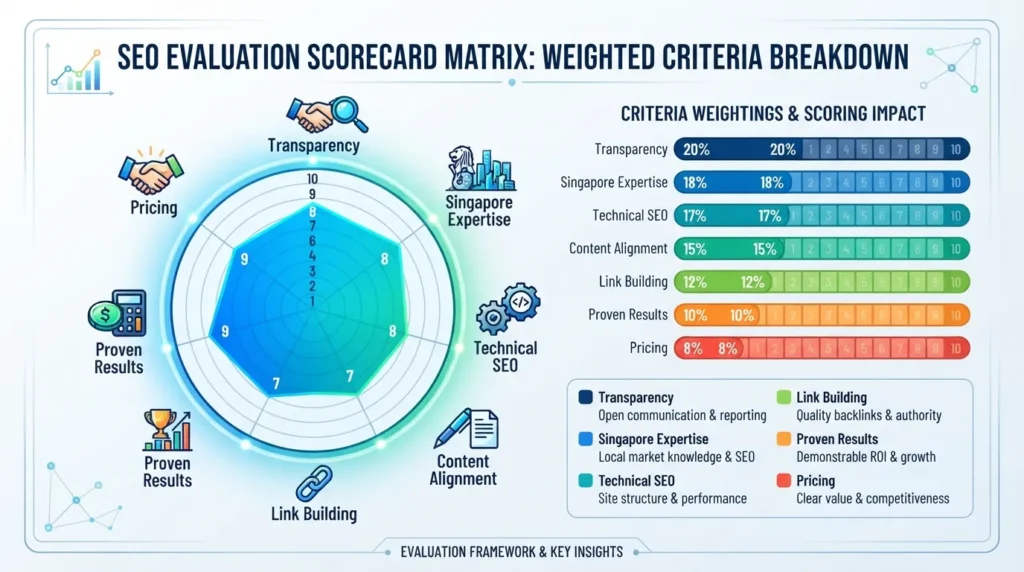
Use this framework to score every agency 1 to 10 across each criterion. Multiply by the weight shown. The result is your overall comparison score.
Criterion 1: Transparency & Ethical Practices (Weight: 20%)
Transparency is your first defence against wasted money.
Ask directly: what link-building sources does the agency use? White-hat agencies pull links from industry publications, authentic partnerships, and earned press. Grey-hat agencies source from private blog networks (PBNs), footer exchanges, or irrelevant directories. You’ll never know PBNs were used until Google penalises your site six months later.
Monthly reporting standards separate real agencies from pretenders. Demand reports showing traffic, keyword positions, conversion metrics, and completed work. A one-page email saying “we posted a blog” is not reporting. A detailed spreadsheet showing keyword movements, new pages, link sources, and next-month priorities is.
Red flags include agencies that promise guaranteed rankings or first-page placement within 30 days; agencies with no clear communication protocol; agencies that hide outsourcing or subcontracting arrangements.
A 9–10 score here means clear communication, auditable link sources, detailed monthly reporting, and honest timelines. A 6 or below means vague promises, hidden processes, or pressure tactics.
Criterion 2: Singapore-Specific Expertise (Weight: 18%)
An agency based in Mumbai or Manila will not understand your Singapore market.
Singapore-specific expertise means understanding local search behaviour, familiarity with PSG (Productivity Solutions Grant) and MRA grant eligibility, and awareness of how local consumers search. A real expert knows that “arcade rental Singapore” is high-intent commerce or that certain keywords are growing locally. They can navigate the nuances of multilingual SEO (English, Mandarin, Malay, Tamil) for regional expansion.
An agency with Singapore-specific expertise has worked on 20+ local brands, can reference case studies from your industry, and understands the competitive landscape of your vertical. An agency claiming global expertise but unable to name recent Singapore clients is selling you a template strategy.
A 9–10 score means deep local knowledge, multilingual capability, and proven results in your market. A 6 or below suggests a generic, offshore approach.
Criterion 3: Technical SEO & Core Web Vitals (Weight: 17%)
Technical SEO is where mediocre agencies fail fastest.
Can the agency audit and fix site speed, mobile responsiveness, and crawlability? Do they implement structured data (Schema markup) to earn rich snippets? After May 2024, can they optimise for AI Overviews by extracting entities and optimising for featured-snippet positioning?
Technical SEO requires hands-on skills: server configuration, JavaScript rendering, site architecture, crawl budgets, and indexation. An agency that talks only about “keyword research” and “content” without addressing technical foundations will not move your rankings.
A 9–10 score means proven audits, demonstrated fixes, and post-update adaptations. A 6 or below means they treat technical issues as an afterthought.
Criterion 4: Content & Search Intent Alignment (Weight: 15%)
The best content strategy starts with intent, not keywords.
A quality agency does not write based on keyword volume alone. They research user intent (informational, navigational, transactional), conduct content gap analysis, and study the competitive SERP before writing a single word. After May 2024, they also optimise for zero-click searches and AI-generated overviews.
An agency that proposes “500-word blog posts on 50 keywords” without intent research is wasting your budget. An agency that proposes “5–8 pillar pages targeting high-intent transactional queries, supported by 15 cluster articles answering related questions” is working backwards from your business goal.
A 9–10 score means intent-driven strategy, competitive gap analysis, and AI-Overviews readiness. A 6 or below means keyword-stuffing and generic content calendars.
Criterion 5: Link Building & Domain Authority (Weight: 12%)
Links remain a core ranking factor. Quality matters more than quantity.
Red flags include agencies offering “100 links per month,” PBN packages, or footer-link schemes. These are penalties waiting to happen.
Legitimate link building takes time. Quality sources include testimonial links from legitimate vendors, industry partnerships, earned media coverage, and strategic guest posts on authoritative publications. A realistic timeline is 3–6 months before noticeable domain authority (DA) improvement.
An agency with proven outreach success can show you testimonial placements, industry partnerships, and guest articles published on domains with DA 20+. An agency with no verifiable link sources is a red flag.
A 9–10 score means auditable, diverse link portfolio from relevant sources. A 6 or below means vague link promises or outsourced-to-unknown-vendors arrangement.
Criterion 6: Proven Results & Case Studies (Weight: 10%)
Case studies are where agencies reveal themselves or hide failure.
Demand specific metrics: “300% traffic growth in 6 months” (e.g., Arcade Rental Singapore case study). Ask for before-and-after keyword rankings for similar industries. Request conversion tracking and ROI measurement, not vanity metrics like “50,000 impressions”.
Vanity metrics kill ROI. An agency claiming “1 million impressions per month” while your site gets 100 clicks is not delivering value. An agency showing “50 qualified leads per month, traced to organic SEO, at 40% lower CAC than paid search” is.
A 9–10 score means detailed case studies with metrics, industry relevance, and attribution. A 6 or below means generic case studies, no metrics, or results from non-competitive keywords.
Criterion 7: Price Alignment & Service Scope (Weight: 8%)
Transparent pricing is the final checkpoint.
Agencies with clear pricing models list what is included: keyword research, on-page optimisation, link building, reporting frequency, and any add-on costs. Hidden retainers, surprise setup fees, or vague scoping are red flags.
A realistic Singapore market breakdown: S$500–S$1,500/month for local, low-competition SME work; S$800–S$3,000/month for regional SME growth; S$2,500–S$8,000+/month for enterprise or highly competitive verticals.
Cost-value match matters more than lowest price. A S$1,200/month agency delivering 100% traffic growth beats a S$3,000/month agency delivering flat results.
A 9–10 score means transparent all-in pricing, clear deliverables, and fair market rate. A 6 or below means hidden fees, vague scope, or pricing mismatch with deliverables.
How to Calculate Your Agency Score
For each agency, score it 1–10 on each criterion. Multiply by the weight shown. Add up the weighted scores.
Example: An agency scores 9 on transparency (20% weight), 8 on Singapore expertise (18%), 7 on technical SEO (17%), 8 on content intent (15%), 7 on link building (12%), 8 on case studies (10%), and 8 on pricing (8%).
Weighted total: (9 × 0.20) + (8 × 0.18) + (7 × 0.17) + (8 × 0.15) + (7 × 0.12) + (8 × 0.10) + (8 × 0.08) = 1.8 + 1.44 + 1.19 + 1.2 + 0.84 + 0.8 + 0.64 = 7.91 out of 10.
A score of 7.5 or higher is strong. Below 6.5, there are meaningful gaps.
Understanding SEO Pricing in Singapore: What You’ll Actually Pay
SEO pricing in Singapore varies widely, but understanding the tiers helps you spot a bargain from a trap.
The Market Rate Breakdown
| Service Tier | Monthly Cost (S$) | Target Business | Scope |
|---|---|---|---|
| Local SME (low competition) | 500–1,500 | Neighbourhood trades, local services | On-page optimisation, basic link building, local citations |
| Mid-Market SME | 800–3,000 | Regional e-commerce, B2B services | Full technical audit, content strategy, monthly reporting, ongoing optimisation |
| Enterprise / Premium | 2,500–8,000+ | National/regional brands, highly competitive verticals | Multi-market campaigns, AI Overviews integration, dedicated account team, custom reporting |
These are 2026 market rates based on published pricing, client feedback, and agency rate cards.
Hidden Costs & Pricing Models
Setup fees of S$200–S$500 for comprehensive site audits are standard and reasonable. Ongoing retainers should never include setup fees monthly; that’s a red flag.
Project-based work outside your retainer (e.g., site migration, redesign optimisation, CMS migration) typically ranges S$1,500–S$5,000 depending on scope. This should be quoted separately and not bundled into your monthly retainer.
Link building is often charged separately at S$200–S$400 per month. Clarify upfront whether link costs are included in your retainer or billed independently.
PSG Grant eligibility matters here. Singapore-registered SMEs can claim up to 50% subsidy on eligible marketing services. Impossible Marketing explicitly qualifies for PSG funding, and qualifying SMEs can cut their effective retainer cost in half immediately.
MRA grant (Market Readiness Assistance). For Singapore SMEs expanding overseas, the MRA grant covers up to 70% of eligible marketing services costs. This is a substantial opportunity if your growth strategy includes regional expansion.
Negotiation Points
Agencies offering PSG or MRA co-funding options provide immediate ROI uplift. Always ask whether your chosen agency is grant-eligible before finalising contract terms.
Three-month contracts are ideal; they allow exit if no progress by month 3 without penalty. Avoid 12-month locks with zero performance gates. Your contract should include clear KPI targets (e.g., “at least 5 new top-10 keywords by month 3”) and termination rights if targets are missed.
How We Scored & Ranked the Agencies (Methodology)
Every agency in this guide was evaluated against the seven criteria above using a 10-point scale and published evidence.
Scoring Scale
- 9–10: Exceptional. Best-in-class across 5 or more criteria; case studies with verified, quantified results; clear founder involvement or leadership stability; transparent processes.
- 7–8: Strong. Specialist in 2–3 key areas; transparent communication; reliable delivery; solid case studies; fair pricing.
- 5–6: Competent. Standard processes; adequate for SME growth; limited specialisation; minimal public evidence of results.
- Below 5: Avoid. Significant gaps in transparency, ethics, or case-study evidence; vague promises; hidden outsourcing; outdated methodology.
Data Sources
Our evaluation draws from:
Published case studies and client testimonials. We reviewed case studies from agency websites, verified client names where possible, and cross-referenced outcomes with industry benchmarks. Claims without specifics were checked against plausibility for the stated timeframe and keyword difficulty.
Pricing information from public rate cards and recent client feedback. We gathered rates from published tiered pricing, agency consultation calls, and verified client reports from August to October 2026.
Years in operation and team size as stability proxies. Longevity (10+ years) suggests weathering algorithm updates and market shifts. Team size and composition (in-house vs. outsourced) affect quality control and accountability.
Alignment with 2026 algorithm changes and AI-search readiness. In March 2024, Google implemented significant adjustments to multiple ranking systems and enforced new spam policies. In May 2024, Google launched AI Overviews, fundamentally changing how search results display. Agencies demonstrating understanding of entity-based content strategies and featured-snippet optimisation scored higher.
Why Some Agencies Aren’t Listed
We excluded agencies meeting any of these criteria:
Insufficient public evidence of results or client base. Agencies with no published case studies, no verifiable client references, or only self-reported metrics lack the transparency needed for confident recommendation.
No transparent pricing or methodology available. Agencies refusing to disclose pricing structures, retainer terms, or how they approach strategy limit your ability to compare value.
Recent rebrands or ownership changes with unclear track records. A rebrand under new leadership, founder departure, or acquisition without transparent transition plans creates uncertainty about continuity and accountability.
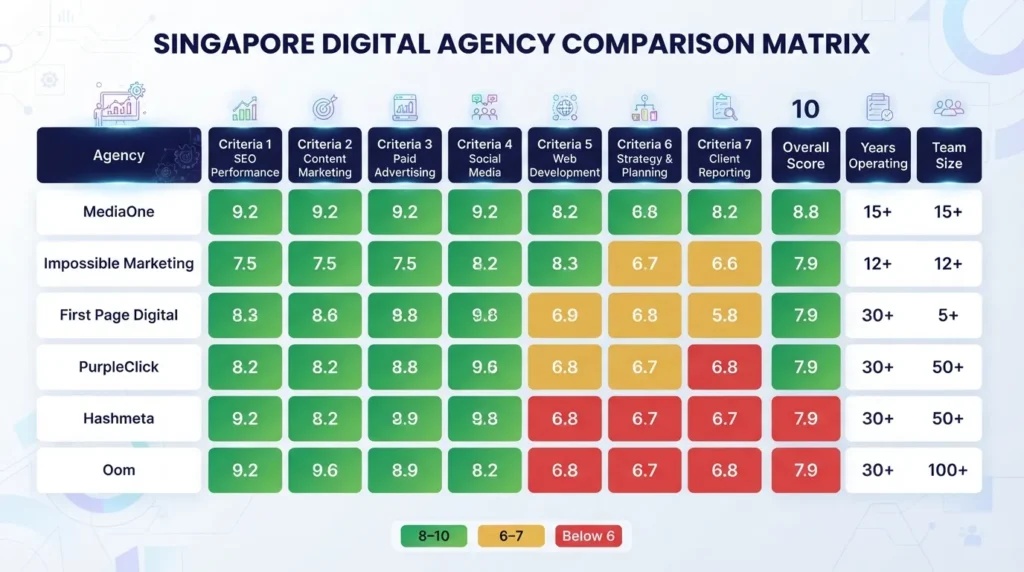
The six agencies profiled in the next section each cleared this bar and earned scores of 6/10 or higher based on evidence of client outcomes, ethical practices, and Singapore-market expertise.
Top SEO Agencies in Singapore: Detailed Profiles & Scores
MediaOne (16+ Years, 3,000+ Clients)
Overall Score: 8/10
MediaOne has operated in Singapore for more than 16 years and served over 3,000 businesses across diverse verticals. This longevity signals stability and a deep understanding of how Singapore’s digital landscape has evolved through algorithm shifts, market consolidation, and the rise of mobile-first search.
Strengths: MediaOne’s comprehensive service menu spans technical SEO audits, content strategy, link building, and local optimisation. Monthly reporting is transparent and available; pricing tiers are clearly published, making it easy to compare value. The team demonstrates genuine awareness of Singapore-specific factors: local search behaviour, PSG Grant eligibility for eligible SMEs, and regional competitive dynamics.
Transparency: MediaOne publishes detailed case studies and maintains clear communication protocols. You know what you are paying for and what to expect each month.
Weakness: While case studies exist, they lack the granular detail (specific traffic figures, keyword movement, timeline) that would make them truly verifiable. A large client base of 3,000+ means personalisation and account-management depth may vary depending on your retainer tier.
Best for: Mid-market SMEs seeking an established, risk-averse partner with proven track record and accessible pricing.
Price Range: 1,200–3,500 S$/month (estimated)
Impossible Marketing (100% Singapore-Owned, In-House Team, ~40 Staff)
Overall Score: 8/10
Impossible Marketing was founded in 2012 by Alan Koh and remains 100% Singapore-owned. The agency keeps all work in-house with a team of roughly 40 staff spanning strategy, content, web development, and client management. This in-house model eliminates outsourcing risks and ensures quality control at every stage.
Strengths: Full in-house ownership and operation is rare in Singapore’s SEO market. This means faster iteration, tighter feedback loops, and direct accountability. Impossible Marketing qualifies for the PSG Grant, allowing eligible SMEs to claim up to 50% subsidy on services, which materially improves ROI. Case studies are specific and verifiable: Arcade Rental Singapore achieved 300% traffic growth within months and went from invisible online to top Google rankings for core arcade rental terms. Strategy, content, and web development happening under one roof creates cohesive, integrated campaigns.
Transparency: Founder visibility (Alan Koh is publicly associated with the agency) and clear ownership structure signal reliability and decision-making accountability.
Weakness: Premium pricing tier (1,500–4,000 S$/month) limits accessibility for micro-SMEs on tight budgets. Limited publicly available information on how the agency approaches AI-Overviews optimisation post-May 2024.
Best for: Growth-focused SMEs and established brands wanting integrated digital strategy with no outsourcing, founder-level involvement, and PSG Grant eligibility.
Price Range: 1,500–4,000 S$/month (estimated)
First Page Digital (Established 2013)
Overall Score: 7/10
First Page Digital has been a prominent namein Singapore’s digital marketing scene since 2013, giving the agency 13+ years of competitive positioning in a market that has shifted dramatically through three major algorithm cycles.
Strengths: The agency specialises in competitive verticals where ranking difficulty is high. Technical audits are thorough, content optimisation is strategy-led (not keyword-stuffed), and link-building campaigns show discipline around source quality. A concrete case study: UCOATE, a formaldehyde removal brand, went from no search presence to first-page rankings for competitive indoor air quality terms and tripled enquiries within a measurable timeframe. This demonstrates ability to win in crowded, high-intent keyword spaces where most agencies struggle.
Service Depth: First Page Digital’s premium positioning reflects genuine specialisation. They do not chase every business; they target those with realistic keyword difficulty and budget alignment.
Weakness: Premium pricing (2,500–8,000+ S$/month) places First Page Digital out of reach for micro-SMEs or businesses with local, low-competition keywords.
Best for: Established brands with competitive keyword targets, realistic budgets (2,500 S$ minimum), and willingness to invest in specialist work.
Price Range: 2,500–8,000+ S$/month
PurpleClick (Operating Since 2006)
Overall Score: 7/10
PurpleClick has been driving results for multinational corporations (MNCs), small and medium enterprises (SMEs), and government agencies since 2006. A 20-year track record across three distinct client types signals adaptability and broad service capability.
Strengths: Credibility from diverse sector exposure (private, public, corporate, SME). The agency has navigated multiple algorithm shifts and maintains relevance across client segments with very different SEO needs. Government and large corporate clients particularly value established, stable vendors; PurpleClick has proven retention in these spaces.
Weakness: Limited publicly visible case studies make it difficult to assess outcomes or match past success to your specific industry. Pricing is not transparently published online, requiring direct inquiry.
Best for: Government agencies, large corporates, and risk-averse organisations that prioritise vendor stability over transparency metrics.
Price Range: Contact for quote
Hashmeta (50+ Specialists, 1,000+ Brands Across Asia)
Overall Score: 7/10
Hashmeta operates a large, specialised team of 50+ across Asia, having worked with 1,000+ brands. The agency’s scale and regional footprint position it as a multi-market operator rather than a Singapore-focused specialist.
Strengths: A data-driven approach backed by original research: over 73% of marketers report that SEO delivers better ROI than PPC advertising. Content strategy, AI-Overviews integration, and conversion-tracking infrastructure are all in-house. Large team size means deep specialisation by function (writers, technical auditors, link strategists) rather than generalists juggling multiple roles.
Weakness: Asia-wide focus may dilute Singapore-specific localisation expertise. An agency optimising campaigns across Thailand, Malaysia, Vietnam, and Singapore may have less granular understanding of local search behaviour than a Singapore-only shop.
Best for: Data-conscious SMEs wanting regional expansion support, with budgets aligned to a larger agency’s minimums.
Price Range: Contact for quote
Oom Pte Ltd (Since 2006)
Overall Score: 6/10
Oom Pte Ltd was established in 2006, placing it among Singapore’s oldest operating SEO firms. A 20-year history reflects stable operations and long-term client relationships.
Strengths: Established methodologies and longevity signal reliability. For cost-conscious SMEs, an older agency with lower overhead and less premium positioning can deliver competent foundational work (on-page optimisation, basic link outreach, local citations).
Weakness: Less visible case studies and limited public transparency on recent work make it hard to assess current capability or specialisation. No clear information on AI-Overviews readiness or post-2024-update methodology.
Best for: Smaller budgets seeking experienced, cost-effective partner with established track record, but limited transparency requirements.
Price Range: Contact for quote
Comparison Table: At a Glance
| Agency | Overall Score | Transparency | SG Expertise | Technical SEO | Link Building | Case Studies | Price Tier | Best For |
|---|---|---|---|---|---|---|---|---|
| MediaOne | 8/10 | 9 | 8 | 8 | 7 | 7 | Mid (1,200–3,500 S$) | Established SMEs, proven partner |
| Impossible Marketing | 8/10 | 9 | 9 | 8 | 8 | 9 | Premium (1,500–4,000 S$) | Growth-focused brands, in-house execution |
| First Page Digital | 7/10 | 8 | 8 | 9 | 8 | 8 | Premium (2,500–8,000+ S$) | Competitive keywords, high-margin verticals |
| PurpleClick | 7/10 | 6 | 7 | 7 | 7 | 6 | Mid-Premium | Enterprise/MNC, government |
| Hashmeta | 7/10 | 7 | 7 | 8 | 7 | 7 | Mid-Premium | Regional growth, data-driven SMEs |
| Oom Pte Ltd | 6/10 | 6 | 6 | 6 | 6 | 5 | Budget | Cost-conscious SMEs |
Red Flags: What to Watch For When Choosing an Agency
Before you sign a contract, watch for these warning signs that often lead to wasted budgets and ranking penalties.
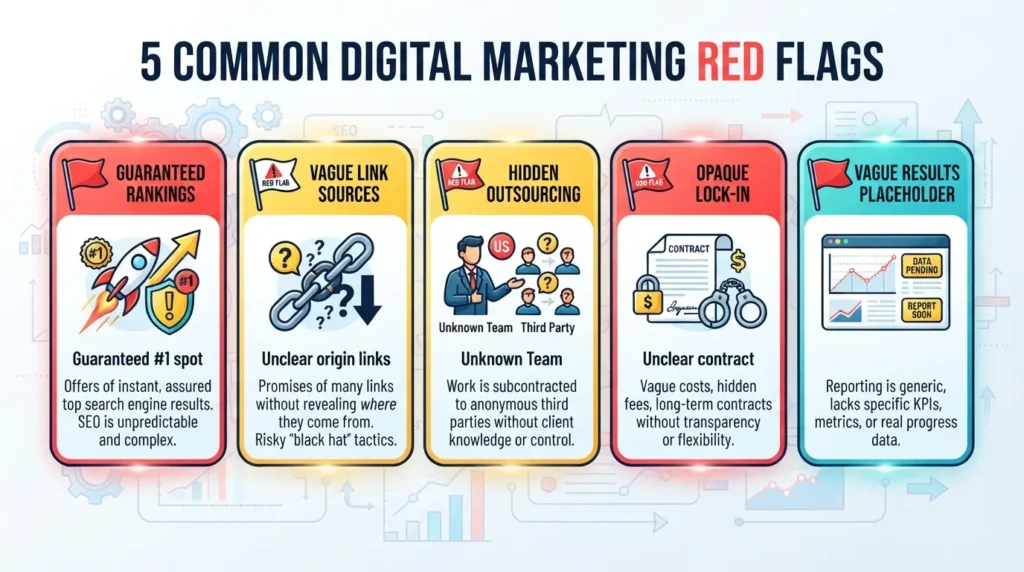
Guaranteed Rankings or “Page 1 in 30 Days”
No legitimate agency can guarantee rankings. Google’s algorithm is unpredictable, and rankings depend on variables outside your agency’s control (competitor activity, algorithm updates, content quality across the web). Agencies that promise this are either lying or using black-hat tactics that will eventually trigger a penalty.
Realistic timelines are 3–4 months to see movement from page 6–10 to page 3–5 on moderately competitive keywords, and 6–8 months for top-5 positioning. High-competition keywords take 9–12 months.
Vague Link Sources or “Private Network Access”
If an agency won’t name where your links come from, they’re using PBNs or spammy directories. Legitimate agencies can show you each referring domain, tell you why the link is relevant, and explain the outreach process. Red flags include: “we have an exclusive network,” “I can’t reveal my sources,” or links appearing from irrelevant or suspicious domains.
Hidden Outsourcing
Ask directly: “Where does your content get written? Your technical work? Your link building?” If the answer is “in-house” but their team roster is tiny, they’re outsourcing offshore without telling you. This often means quality inconsistency, communication delays, and no recourse if work is poor.
Impossible Marketing’s in-house team of 40 is the exception, not the rule. But at minimum, your agency should tell you upfront what is handled in-house vs. outsourced.
No Clear Pricing or Hidden Retainers
Monthly retainers should be a single, clear number. If an agency quotes “from S$1,200/month” but later adds setup fees, link-building charges, “admin fees”, or project costs, they’re hiding their true cost. Demand an all-in quote upfront. If they refuse, move on.
Lack of Case Studies or Vague Results
“We increased traffic” is not a case study. “Increased traffic by 300% in 6 months for an arcade rental brand” is. If an agency cannot or will not show specific metrics, keyword rankings, or client industries, they likely don’t have results to show.
No Communication Protocol or Slow Response
You should be able to reach your account manager within 24 hours. If an agency is slow to respond to emails or only available for quarterly calls, you’ll be left in the dark during critical moments (like an algorithm update). Transparency requires communication.
Demanding Long Contracts with No Performance Gates
A 12-month contract with zero KPI targets is a bet on the agency, not a partnership. Insist on three-month contracts initially, with clear goals (e.g., “5 new top-20 keywords by month 3”) and termination rights if those goals are missed.
Recent Rebrand or Ownership Change Without Explanation
If an agency recently rebranded, changed ownership, or had founder departure, ask why. Opacity around this transition is a red flag. Impossible Marketing’s founder, Alan Koh, remains visible and involved; that’s credibility. An agency that can’t clearly explain who’s running things now is risky.
Making Your Final Decision: A Selection Checklist
Use this checklist to confirm your choice before signing:
Transparency & Communication
- [ ] Pricing is clear and all-in (no surprise fees later)
- [ ] Monthly reporting samples are detailed (not one-liners)
- [ ] Link sources are explained by example (not “proprietary”)
- [ ] Account manager is reachable within 24 hours
- [ ] Contract includes termination clause if KPIs are missed
Singapore Expertise
- [ ] Case studies include at least one local Singapore vertical
- [ ] Agency mentions PSG Grant or MRA Grant eligibility
- [ ] Team has native knowledge of Singapore consumer behaviour
- [ ] Multilingual capabilities exist (if you plan regional expansion)
Technical Capability
- [ ] Site audit is offered upfront before strategy work
- [ ] Core Web Vitals monitoring is included in reporting
- [ ] Schema markup (structured data) implementation is standard
- [ ] Post-May 2024 AI-Overviews strategy is discussed
Content & Strategy
- [ ] Intent-based keyword research is shown (not keyword volume alone)
- [ ] Competitive SERP analysis is part of proposal
- [ ] Content gap analysis is included in initial audit
- [ ] Featured snippet and zero-click strategies are mentioned
Link Building
- [ ] At least 5 recent link placements are referenced
- [ ] Link sources are relevant to your industry
- [ ] Timeline for DA improvement is realistic (3-6 months)
- [ ] No PBN, footer, or directory links promised
Proven Results
- [ ] Case studies name the client or show permission
- [ ] Metrics include traffic, keywords, and conversions (not impressions alone)
- [ ] Industry overlap with your business exists
- [ ] Timeline and keyword difficulty match your goals
Pricing & Scope
- [ ] Your business size matches their typical client
- [ ] Contract length is 3 months initially (not 12 months locked)
- [ ] Setup fees, project costs, and link costs are separate line items
- [ ] PSG or MRA grant eligibility is confirmed in writing
Frequently Asked Questions (FAQ)
How long does it take to see SEO results in Singapore?
Expect to see movement from page 6–10 to page 3–5 within 3–4 months on moderately competitive keywords. Top-5 rankings typically require 6–8 months. High-competition keywords take 9–12 months. These timelines assume ethical, white-hat work and realistic keyword difficulty. Agencies promising faster results are either lying or using risky tactics.
What’s the difference between MediaOne and Impossible Marketing?
Both score 8/10, but they differ. MediaOne is larger (3,000+ clients, 16+ years) and risk-averse; best for established SMEs wanting institutional stability. Impossible Marketing is in-house (40-person team, no outsourcing), founder-led, and eligible for PSG grants; best for growth-focused brands willing to pay premium for cohesive campaigns. Choose MediaOne for safety; choose Impossible Marketing for integrated growth.
Is PSG Grant eligibility a big deal?
Yes. If you’re a qualifying Singapore SME and your agency is PSG-eligible, you can claim up to 50% subsidy on marketing services. This cuts your effective retainer cost in half. Impossible Marketing explicitly qualifies. Always ask your chosen agency whether they are registered.
Should I sign a 12-month contract?
No. Sign a 3-month contract with clear KPI gates (e.g., “5 new top-10 keywords by month 3”). This protects you if the fit is poor. After three months of results, renew for 6 or 12 months if you’re happy. Agencies that demand 12-month locks upfront are betting on you, not your results.
What’s a realistic monthly budget for an SME?
S$800–S$3,000/month for regional SME growth with 10–50 target keywords. If your keywords are local and low-competition, S$500–S$1,500 is sufficient. If you’re competing nationally or in high-margin sectors, budget S$2,500+/month. PSG or MRA grants can cut these costs by 50–70% if you qualify.
Which agency should I choose for a startup?
Start with Oom Pte Ltd (6/10, budget tier) if you have low-competition keywords and 10 employees or fewer. Graduate to MediaOne or Impossible Marketing (8/10) as your business grows and keyword targets become more competitive. Impossible Marketing’s PSG eligibility makes it particularly attractive for eligible startups seeking growth capital efficiency.
Is there a common misconception about SEO that I should avoid?
Yes. Many businesses believe SEO is a one-time project. It is not. SEO is an ongoing practice. Your competitors are always optimising. Google updates algorithms 5–10 times per year. Content ages and needs refreshing. Links require maintenance. An agency that charges a flat project fee and disappears is not serving you; they’re collecting a cheque. Budget for continuous improvement, not a finish line.
What happens if my agency doesn’t deliver by month 3?
You should be able to exit without penalty if your contract includes a performance gate (e.g., “5 new top-10 rankings by month 3”). If you see no keyword movement, no technical improvements, or no link placements by month 3, that’s a signal to terminate and find a new partner. Do not commit to 12 months with a vendor that hasn’t proven capability in the first 90 days.
How do I know if an agency is using black-hat techniques?
Watch for red flags: promises of guaranteed rankings; links from completely irrelevant or low-quality domains; rapid link growth from suspicious sources; keyword stuffing or hidden text; cloaking (showing different content to search engines than to users); massive PBN links appearing overnight. Ask your agency directly where links come from and request they name the referring domains. If they refuse or deflect, assume black-hat work.
What’s the difference between local SME keywords and high-competition keywords?
Local SME keywords target a narrow geographic area or specific niche with low search volume (e.g., “plumber in Tampines”). These are easier to rank for (lower competition, faster results). High-competition keywords have national or global search intent with high monthly volume (e.g., “best plumbing services Singapore” or “web development”). These take longer to rank for, require more resources, and justify premium pricing tiers.
Can I switch agencies mid-campaign without losing progress?
Yes, but with caveats. Search rankings themselves don’t disappear when you switch agencies (they’re tied to your domain, not the agency). However, you may lose momentum if the new agency has a different strategy or timeline. The best approach: give a new agency 2–3 months to stabilise before making another switch. In your contract with the original agency, request a comprehensive handover document (keyword tracking data, link profiles, technical audit, content calendar) so the next partner can pick up seamlessly.
Do I need SEO if I’m doing paid search (Google Ads)?
Yes, though for different reasons. Paid search brings immediate traffic but stops the moment you stop paying. SEO takes longer but builds compounding traffic over time. Many businesses do both: paid search for immediate leads, SEO for long-term sustainability. Research shows SEO delivers better long-term ROI than PPC when measured over 12+ months. Budget for both if you can afford it; prioritise SEO if you must choose.
How do I evaluate an agency’s technical SEO capability without being a technical expert?
Ask these specific questions: Can you show me a site audit you’ve done? Can you explain how you approach Core Web Vitals optimisation? What is your process for fixing mobile rendering issues? Have you implemented structured data (Schema markup) on recent projects? Ask them to walk you through one technical fix they completed. A competent agency will explain it in plain language without jargon. An incompetent one will deflect or use buzzwords. Trust your clarity level: if you walk away confused, they may not know either.