Singapore’s digital landscape shifted fundamentally in 2026. Users no longer search only through Google’s blue links. They ask ChatGPT, Bing Copilot and other AI engines to find answers, and those engines cite sources they deem authoritative. Traditional SEO rankings have become insufficient. Your business now needs visibility across both search engines and AI-powered answer engines to compete. This shift demands a different kind of agency: one that measures AI citations, optimises content for answer engines, and proves results with real data. Most agencies in Singapore still operate using 2023-era SEO playbooks. This guide identifies which agencies have adapted to 2026’s reality and how to evaluate them fairly.
Key Takeaways
- AI search (ChatGPT, Copilot, Google AI Overviews) now drives material traffic and decision-making alongside traditional Google search.
- Answer Engine Optimisation (AEO) is no longer optional: agencies must optimise for AI citations, not just keyword rankings.
- AI Studio’s case study (8 answer-first pages, 38,573 Copilot citations over one quarter) shows the potential of proper AEO execution.
- When evaluating agencies, demand evidence of AI search results, proprietary tracking, and defined AEO methodology.
- Founder expertise (10+ years), team scale, and infrastructure matter: newer agencies may have AI knowledge but lack the execution discipline of established firms.
What Is AI SEO and Why It Matters for Singapore Businesses
AI SEO is the integration of artificial intelligence into search engine optimisation strategy. It goes beyond traditional keyword ranking to include AI-powered content generation, automated audit tools, and answer engine optimisation (AEO).
The difference between traditional SEO and AI SEO
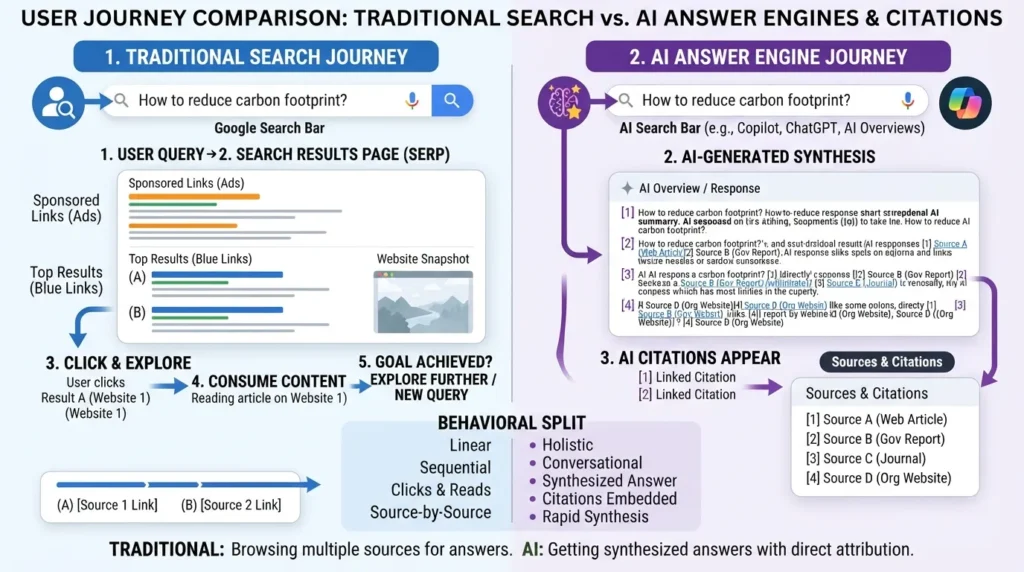
Traditional SEO optimises for Google’s ranking algorithm. A page ranks if it matches search terms, has authority, and meets technical standards. You measure success by keyword rankings and organic click-through.
AI SEO optimises for user intent across multiple search channels: Google, ChatGPT, Bing Copilot, and Google’s AI Overviews. You win visibility not just by ranking in organic results, but by having your content cited as a source by AI answer engines. You measure success by both organic rankings and AI citations.
This distinction matters because your audience is splitting. Some users still click through Google results. Others now ask ChatGPT or Copilot a question and read the AI’s answer, which may cite your content as a source (or may not mention you at all).
How search behaviour has changed
Users increasingly rely on AI engines to answer their questions. This behaviour shift is particularly acute in Singapore, where adoption of ChatGPT and Copilot has accelerated. An AI engine answering a question may cite multiple sources, or it may synthesise an answer without citing you, even if your content is the most relevant.
The competitive disadvantage of ignoring AI search is now measurable. B Thrust’s research documents how companies that do not optimise for AI engines are becoming invisible to users searching via answer engines. Your traditional Google ranking means nothing if ChatGPT users never learn you exist.
Why Singapore businesses must adapt now
Singapore businesses now compete for visibility in both traditional search and AI-powered answer engines. A user in Singapore searching for “best digital marketing agency” might search Google, or they might ask Copilot. If your content is optimised only for Google, you lose half your potential audience.
Answer engine optimisation (AEO) is the practice of structuring your content so that AI engines cite you as a source. This requires different content design: shorter, quotable answers to specific questions; structured data that AI engines can parse; and positioning your business as an authority on specific topics.
An AI SEO agency that only optimises for Google keyword rankings is no longer a full-service SEO partner in 2026. The best agencies now offer AEO as core to their strategy, not as an add-on.
The New Reality of AI Search in 2026
The search landscape has fundamentally shifted. In 2026, users no longer rely exclusively on clicking through organic results to find answers. Instead, millions now open ChatGPT, Bing Copilot, or Google’s AI Overviews and ask conversational questions, expecting the AI engine to cite credible sources in response.
The AI search engines reshaping discovery
Copilot, ChatGPT, and answer-first indexing have become primary discovery channels. Users ask these engines open-ended questions like “What are the best digital marketing strategies for Singapore startups?” or “How do I audit my website for technical SEO issues?” The AI then synthesises an answer and cites the sources it drew from. Your business either appears as a cited source in that answer, or it remains invisible to that user.
This is fundamentally different from traditional SEO, where you optimise to rank for keywords and users click through to your page. In AI search, the AI engine answers the user’s question on its own interface, and you gain visibility only if your content is structured, authoritative, and answer-focused enough for the engine to cite you.
Answer engine optimisation: winning AI visibility
Answer Engine Optimisation (AEO) is the practice of structuring content so that AI engines will cite you as a source when answering user questions. It differs from traditional SEO in that you are not optimising for keyword ranking; you are optimising for being quoted.
AI Studio demonstrated this principle in July 2026 when they published eight answer-first pages designed specifically for AI citation. The results were measurable: Bing Copilot citations of their client’s site grew from approximately 34 per day to a peak of 3,487 daily citations. Across the quarter, the site accumulated 38,573 Copilot citations. This is not organic click-through traffic in the traditional sense; it is visibility in the AI engine itself, leading to traffic, brand mentions, and authority signals.
The structure matters. Answer-first pages prioritise direct, quotable answers to specific questions. They use clear headings, structured data, and passage-level optimisation so the AI engine can extract and cite relevant sections without ambiguity.
User intent across AI and traditional search
The best agencies now recognise that user intent spans both channels. A single user might search Google for one query, then ask Copilot a follow-up question to explore deeper. Your content must satisfy both pathways.
This means agencies focus on the underlying question the user is asking, whether they pose it to Google or Copilot. Traditional keyword-based SEO optimises for “best AI SEO agency Singapore” and tries to rank for that phrase. AI-native SEO asks: “What question is a business owner asking when they search that phrase?” Then it structures content to answer that question comprehensively, making it quotable for both traditional search and answer engines.
The competitive disadvantage of ignoring AI search
Businesses that continue optimising only for traditional Google rankings are gradually becoming invisible to their audience. Users asking AI engines do not see your pages; they see competitors who have optimised for AEO. Your Google rankings mean nothing if your content never appears in the AI answer.
For Singapore businesses competing in both local and regional markets, this is critical. A competitor using AEO will dominate AI search visibility, accumulating citations and traffic from Copilot and ChatGPT, while traditional-only SEO agencies leave that channel entirely uncontested.
Core Evaluation Criteria for AI SEO Agencies
Choosing the right AI SEO agency comes down to seven measurable criteria. These are not generic; they separate agencies that have genuinely adapted to 2026’s search reality from those offering traditional SEO under a new name.
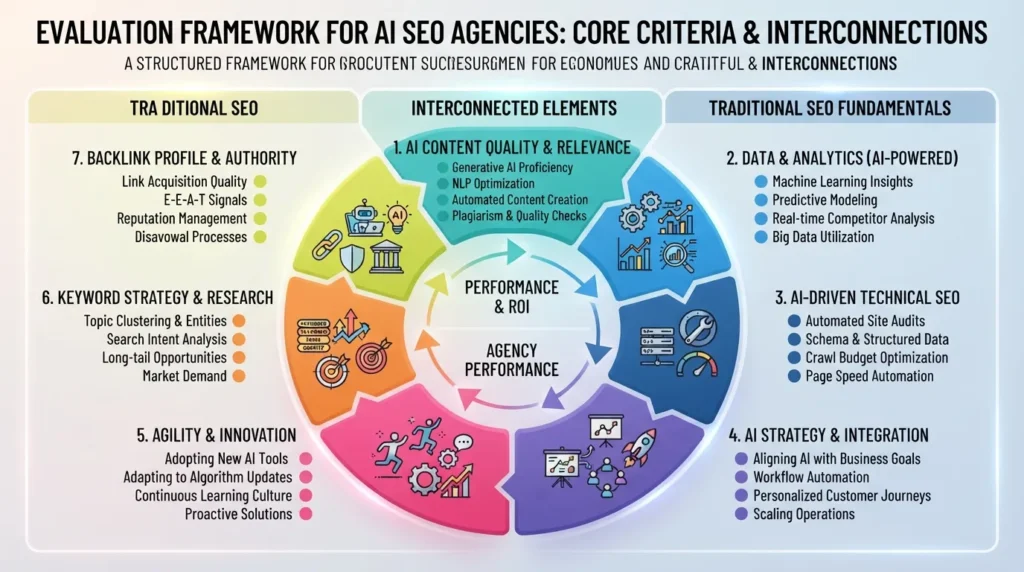
The seven evaluation standards are:
- AI-powered SEO services depth: Does the agency offer AI audit tools, content optimisation specifically for answer engines, and answer-engine targeting as core offerings, not bolt-ons?
- AEO and GEO capabilities: Can they optimise for both answer engine visibility (how ChatGPT and Copilot cite you) and geographical intent (serving Singapore searchers versus global audiences)?
- Proprietary tracking tools: Do they measure visibility in Copilot, ChatGPT, and Google’s AI Overviews, or do they rely only on traditional organic ranking trackers?
- Platform coverage and integration: Can they orchestrate strategy across search, AI answer engines, and paid channels in a unified approach, or do they silo SEO from the rest of your digital presence?
- Audit and strategy phase rigour: Do they conduct a proper discovery phase (technical audit, competitor analysis, content gap audit, intent mapping) before recommending changes, or do they jump straight to execution?
- Optimisation and scaling phase execution: Can they deliver measurable results between months 3 and 6 of a contract, with clear tracking of both organic rankings and AI engine citations?
- Founder expertise and team scale: Does the leadership bring at least 10 years of deep SEO experience, and does the team have the infrastructure (staff, tools, processes) to execute across multiple client accounts?
Why these criteria matter: An agency might offer traditional SEO services competently. But only those with native AI capabilities, proprietary tracking, answer-first content strategy, and proven AEO execution can win visibility in 2026. A business that partners with an agency strong in criteria 5 and 6 but weak in criteria 2 and 3 will rank for keywords while competitors own the AI search channel.
The framework also separates confidence from claim. An agency claiming “AI SEO expertise” but unable to show month-on-month Copilot citations, answer-engine case studies, or proprietary tracking tools has not yet built the infrastructure to deliver. You need evidence, not promises.
This is why the ranking below ties each agency’s score directly to observable facts: founder credentials checked against LinkedIn, case studies verified by published dates and metrics, and tool capabilities confirmed through public announcements or client work. An agency that scores 5 out of 5 on proprietary tracking has published proof of measuring AI search visibility. One that scores 2 out of 5 either lacks that capability or has not made it public.
How We Scored Each Agency
Every agency in this ranking meets a specific evaluation framework. Understanding how we arrived at each score means you can assess whether that agency is right for your business.
The Scoring Scale and Evidence Requirements
Each agency is scored 1 to 5 points per criterion, with 5 representing best-in-class and 1 representing absent or unproven capability. A score of 3 means the agency has demonstrated that capability in public case studies or testimonials; a score of 4 means they have shown consistent excellence; a score of 5 means they have proprietary proof or measurable evidence of competitive advantage.
Scores are backed by published case studies, founder credentials verifiable on LinkedIn or company sites, or documented metrics (such as Copilot citation counts or project timelines). Agencies that claim AI SEO capability without public proof score lower.
Weighting: Why Some Criteria Matter More
Proprietary tracking, AEO capability, and audit rigour carry the highest weight because these are the hardest to fake. An agency that publishes a case study showing it improved Copilot citations from 34 to 3,487 daily has done what traditional SEO agencies have not. An agency that owns proprietary tracking tools for AI search visibility has invested capital and engineering effort that commodity SEO shops cannot replicate.
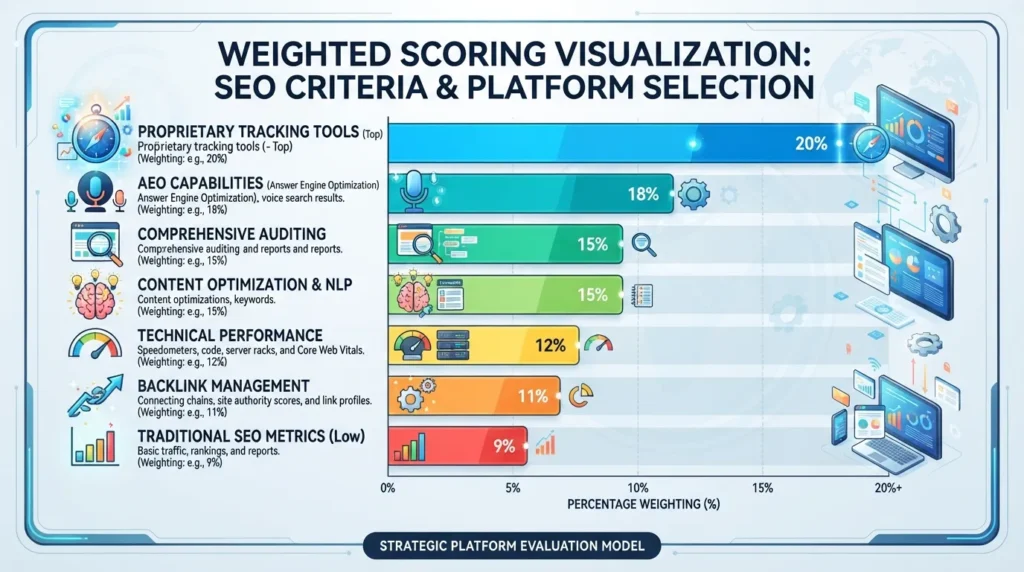
Agencies that score highly on generic SEO (audit and scaling execution) but show no evidence of AEO or AI search measurement rank below those demonstrating both traditional SEO rigour and answer-engine optimisation.
Why Some Agencies Were Excluded
Several established SEO agencies in Singapore were reviewed but not ranked because their public portfolios, case studies, and published articles do not mention answer engine optimisation, AEO, or AI search visibility measurement. If an agency does not publicly demonstrate AI SEO work, we cannot verify it has invested in this capability. Being well-known for traditional SEO does not transfer to leading in AI SEO; agencies slow to adopt AEO are now losing visibility to competitors who have.
This approach is deliberate. A 2026 business choosing an AI SEO agency needs to know which firms have actually adapted their methodology, tools, and case studies to the answer-engine-first market, not which firms have the longest client list from 2015.
FAQ: Choosing an AI SEO Agency in Singapore
What is the difference between AEO and traditional SEO?
Traditional SEO optimises pages to rank in Google search results. AEO optimises pages to be cited by AI answer engines like ChatGPT and Copilot. Both matter in 2026; neither alone is sufficient. The best agencies do both simultaneously.
How much should I expect to pay for AI SEO services?
Pricing varies by agency and scope. Expect to invest from about $5,000 per month for smaller engagements, increasing with team size and complexity. Premium agencies with proprietary tools and proven track records charge more because they can demonstrate results.
How long before I see results in AI search citations?
Results vary, but expect the audit and strategy phase to take two months, with measurable citation growth appearing in months three through six. Agencies promising faster results are likely cutting corners on strategy.
Can traditional SEO agencies do AEO work?
Some can, but many have not yet invested in the tools, training, or case studies to prove it. Before signing, ask for published examples of AEO work and month-on-month citation tracking. If they cannot provide these, they are still learning.
Why does proprietary tracking matter?
An agency that cannot track your Copilot citations, ChatGPT mentions, and AI Overview visibility has no way to prove whether their AEO strategy is working. Proprietary tools signal investment in measurement infrastructure that generic ranking tools do not provide.
Should I hire an agency based only on its Google rankings?
No. In 2026, traditional Google rankings are insufficient proof of capability. Insist on evidence of AEO results, AI search measurements, and a defined methodology for answer engine optimisation. A traditional-only agency is no longer a complete SEO partner.